
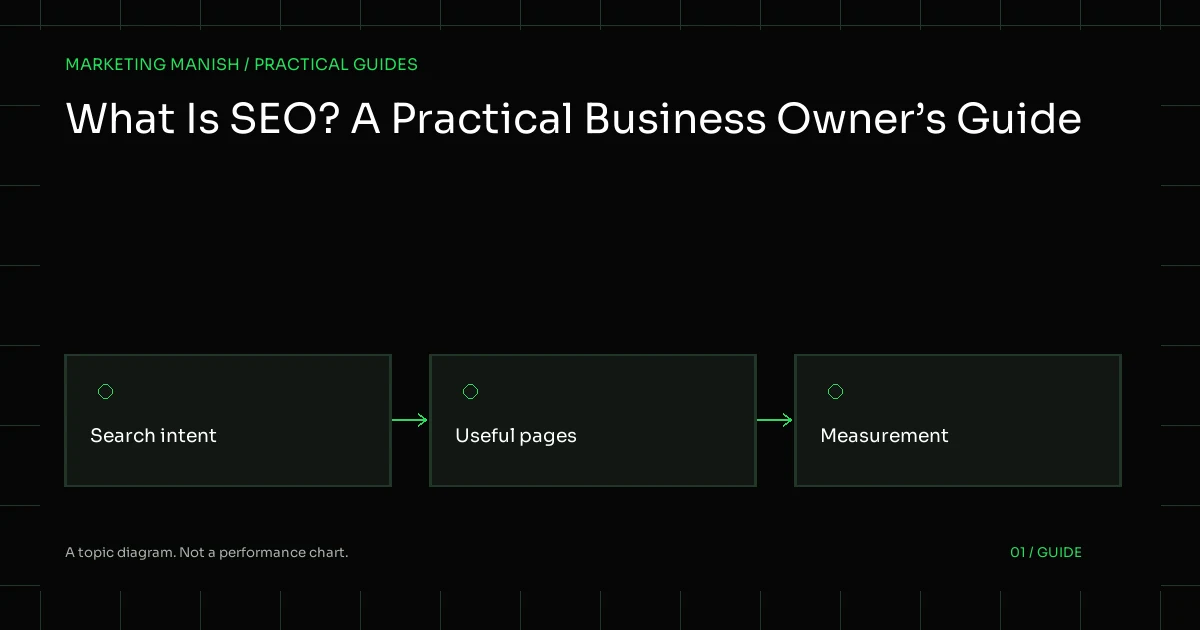
What is SEO? For a business owner, the useful answer is a process for making relevant pages easier to discover, understand and use through organic search. It includes technical work, clear information and sensible connections between pages. It does not mean paying a search engine for a particular position, and it cannot guarantee that a visitor will become a customer.
Imagine a hypothetical repair business with a website that says only “quality service at the best price.” A potential customer still needs to know what can be repaired, which areas are served, what to prepare and how to make an enquiry. SEO work should help those questions meet useful pages. Adding the same phrase to the page repeatedly would leave the real problem unresolved.
How a search journey reaches your website
Search systems discover URLs, fetch accessible information, decide what to retain and select results for a query. These are related stages, but they are not interchangeable. A page can be accessible without being selected for indexing, and an indexed page may not appear prominently for the query you care about. An owner therefore needs more than a single ranking screenshot to understand the situation.
Start with a small set of important pages. Can a visitor reach them through navigation? Do they return the intended response? Is the main information visible without an unusual interaction? Are titles and headings descriptive? These questions connect the search process to ordinary website quality. They also help separate a technical access problem from a page that simply does not answer a useful question well.
Google’s SEO Starter Guide provides an official starting point. Use it to understand the fundamentals, then evaluate recommendations against your own website rather than treating every tool warning as an instruction.
The technical foundation: remove obstacles carefully
Technical SEO concerns the systems around your information. Examples include redirects, status codes, canonical URLs, indexing directives, internal navigation and loading behavior. The goal is not to make a dashboard look flawless. The goal is to remove problems that interfere with useful pages or a dependable visitor experience.
A technical recommendation should name the affected pages, explain the issue and describe how completion will be verified. “Improve speed” is too vague to assign. “Reduce the oversized hero image on the service template and check mobile loading and layout stability” is a more actionable task. The same principle applies to indexing: explain why a page should or should not be discoverable before changing directives.
Use a backup and a review process for changes that affect URLs or indexing. A careless redirect or robots rule can create a larger problem than the original warning. A technical SEO review should prioritize issues by relevance and implementation risk, not merely export a long list.
The content foundation: answer the actual decision
Content SEO starts with intent. Someone learning what a service involves needs a different page from someone comparing providers or requesting a quotation. A useful page makes its purpose apparent and supplies the detail appropriate to that decision. Clear scope, limitations, process and next steps can be more valuable than a long introduction repeating the topic.
For a hypothetical industrial supplier, relevant detail might include applications, verified specifications and the information required for a quote. For a local appointment business, it might include eligibility, preparation and how booking works. These examples describe planning possibilities; they are not client stories or evidence of marketing performance.
Write from real expertise and verify claims before publication. AI can organize research or suggest a structure, but it should not invent product facts, experience or customer outcomes. An on-page optimization plan should improve the answer and its organization, not set a mechanical keyword-density target.
The trust foundation: demonstrate what is real
People need reasons to believe a page. Those reasons can include accurate business information, original explanations, clear ownership, appropriate sources and genuine evidence. An empty testimonial section is preferable to a fabricated review. A small business does not need to pretend it has a large team or a long client history to explain its service responsibly.
External references and links should arise from useful work and legitimate relationships. Buying a bulk package of supposedly powerful links can introduce risk without improving the business’s actual credibility. Ask what the proposed activity contributes, who controls any placement and whether a commercial relationship needs disclosure.
Trust also depends on the site’s everyday behavior. Broken forms, inconsistent contact details and unsupported promises create uncertainty. SEO should be coordinated with those issues instead of being separated from the customer’s experience after a click. Visibility without a usable next step is an incomplete system.
Choose useful queries, not just large numbers
Keyword research is a way to understand how people describe needs. Begin with your services, customer questions and the situations you can genuinely help with. Group similar questions by purpose before deciding whether they need separate pages. Several phrases may belong on one clear service page rather than several near-identical URLs.
Search-volume estimates can offer context, but they are not a forecast of your traffic or enquiries. A broad phrase may attract many people who are not buyers. A narrower question may reveal the exact information a relevant prospect needs. Review the search results and your own business fit rather than choosing topics solely because a spreadsheet number looks impressive.
Map each priority group to a page and a sensible next step. If the business cannot answer the question accurately or provide the service, do not create a page just to capture the phrase. The keyword plan should reflect delivery capability and real knowledge.
Set expectations about time and responsibility
SEO is continuing work, with timing influenced by the website, competition, implementation pace and search-engine decisions. A provider can commit to a scope, communication and verification process. It cannot honestly commit a search engine to a ranking deadline. Ask what the first stage will establish and what evidence will guide later work.
Responsibilities should be explicit. Who supplies subject expertise? Who approves content? Who changes templates? Who reviews enquiries and reports whether they were relevant? A plan can stall when everyone assumes someone else owns those steps. The owner should also retain control of the domain, hosting and measurement accounts.
Distinguish planned deliverables from hoped-for outcomes. An audit, a repaired template or a reviewed article is a deliverable. Improved visibility and useful enquiries are outcomes to evaluate with evidence. Both matter, but presenting one as proof of the other makes reporting less trustworthy.
Measure the path beyond a ranking screenshot
Begin with working measurement and a baseline. Search Console can help explain organic-search activity, while website analytics can provide consent-dependent behavior data. A CRM or enquiry register can show what the business actually received. These systems may not match perfectly because their definitions and visibility differ.
Review page groups and meaningful changes rather than reacting to every daily fluctuation. Ask which useful pages are being discovered, whether visitors can complete the intended action and whether enquiries fit the service. Keep a dated record of major changes so observations have context. Do not attribute every improvement or decline to the latest edit without investigating alternatives.
A broader SEO service plan should connect those observations to the next priorities. Good reporting makes uncertainty visible and helps the owner decide what to do next; it does not hide missing evidence behind a colorful score.
Use a small working example before expanding
Choose one service the business genuinely wants to provide and one audience it understands. Write the questions a person would ask before contacting you: what is included, what is excluded, what affects the scope and what information is needed next. Then compare those questions with the existing page. This exercise creates a specific editing brief without pretending to know how much additional traffic the page will receive.
Now follow the journey. A visitor reads the page, selects an enquiry option, completes required details and receives an accurate acknowledgement. Someone inside the business needs to see the stored enquiry, decide whether it fits and respond. If the page attracts relevant attention but that process is broken, fixing the handoff can be a more sensible priority than publishing another guide.
Give the review a clear stopping point. Record the agreed edits, verify that they are live and note what evidence can reasonably be observed next. Do not rewrite the entire website merely because one page needs improvement. A small, well-verified change is easier to learn from than a collection of simultaneous changes with no record of what happened.
Finally, ask whether the business has the capacity to maintain the plan. Services, opening arrangements, product details and common questions can change. An owner should know who updates those facts and who checks the website after a release. SEO becomes more useful when it is part of normal business maintenance rather than a mysterious activity owned entirely by a report.
A practical starting checklist
- List the services and audiences the business can genuinely serve.
- Choose the important pages and confirm they are reachable and useful.
- Check technical access before assuming a content problem.
- Write clear titles, headings and explanations around each page’s purpose.
- Use only real proof, accurate business details and verified facts.
- Connect related pages with descriptive internal links.
- Define a useful enquiry and verify the form actually stores it.
- Agree on access, ownership, implementation responsibilities and reporting.
You can handle some of this yourself, especially on a small, understandable website. Bring in help when technical complexity, editorial capacity or the need for independent review justifies it. Start with a free SEO audit request if you want to identify a practical next step before agreeing to paid work.