

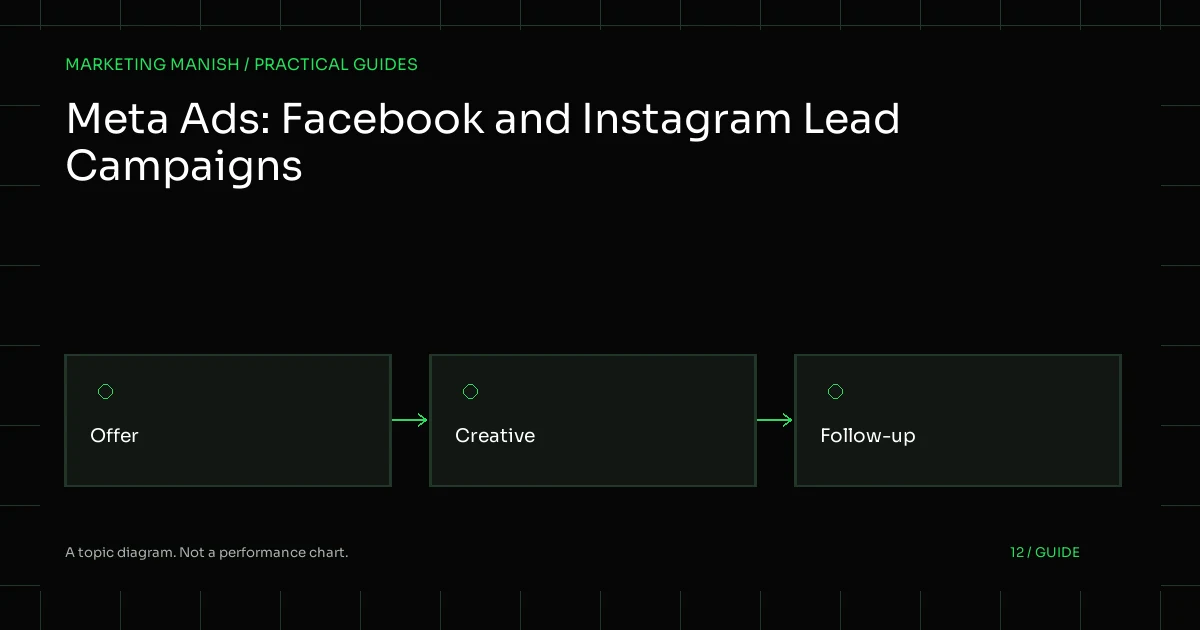
Facebook and Instagram ads for leads need more than an audience and a bright creative. The business needs a clear offer, an appropriate campaign objective and a dependable process after someone expresses interest. A low cost per form is not automatically a useful result if the enquiries do not fit or nobody follows them up.
This guide uses hypothetical planning examples and makes no lead-volume or sales promise. Meta controls its platform, interfaces and approvals, which can change. Use current official guidance for the precise setup, and keep the owner’s budget, permissions and business constraints visible throughout the campaign.
Define the offer before choosing settings
Write down what the business is inviting someone to discuss or request. An offer should explain who it is for, what is available and what happens next. Avoid an exaggerated promise that attracts attention but cannot be supported by the landing page or the actual sales process.
A hypothetical service campaign could invite a clearly scoped consultation or quotation request. It should not imply that every enquiry will produce a fixed commercial result. The business needs to approve the facts, exclusions and any eligibility conditions before those ideas become creative assets.
Use the offer to define qualification. Which services, areas, timing or other practical constraints matter? Collect only the information needed for the next step. Qualification should improve relevance without turning the first interaction into a request for unnecessary private details.
Choose an objective that matches the intended action
Campaign objectives tell the platform what kind of activity is being sought. Understand the current choices rather than selecting a familiar label from an old tutorial. A campaign optimized for attention should not be reported as though it were designed and measured for qualified enquiries.
Consult Meta’s official advertising-objective information and check the actual options available in the account. Access, eligibility and interface details can differ. If a feature is unavailable, record that limitation rather than pretending the planned workflow is already active.
Keep the business outcome separate from the platform’s event definition. An instant-form completion, a website submission and a closed sale are different stages. Reports should explain which stage is measured and what evidence exists beyond it.
Plan the audience responsibly
Begin with the real audience and the offer’s relevance. Avoid assumptions about personal circumstances or sensitive characteristics. The creative and targeting must be reviewed for applicable policies, especially when a sector or claim involves health, finance, employment or another sensitive subject.
Customer lists and event data are not just technical inputs. Review permission, purpose, platform terms and privacy requirements before connecting them. Possession of an email address or phone number does not automatically justify every advertising use, and a marketer should not silently upload business records to simplify setup.
Explain the limits of targeting and automation to the owner. A selected audience is not a guarantee that every impression reaches a suitable buyer. The campaign still needs relevant creative, suitable qualification and feedback from the actual enquiries it produces.
Create a testable creative idea
A useful creative test asks a clear question. You might compare an explanation of the service process with a direct offer introduction, while keeping the underlying facts consistent. Randomly changing colors, copy, format and audience together can make it harder to understand what was learned.
Use original or properly licensed material and accurate claims. Do not present stock people as the team or a generated scene as a completed customer project. If a testimonial or case study is unavailable, leave it out and communicate the process honestly.
Make the first message understandable without requiring a long caption. Then use the caption and landing page to add the detail a person needs. Check subtitles, contrast and mobile framing so the creative remains usable in the contexts where people will encounter it.
Compare instant forms with a website journey
Instant forms can reduce the effort of responding within the platform. A website journey can provide more space to explain the offer and establish context. Neither option is automatically superior. The right choice depends on qualification, the information needed and the business’s ability to handle the resulting conversations.
For a hypothetical complex service, additional context and a few appropriate questions might reduce unsuitable enquiries. For another offer, an unnecessarily long page could create friction without improving the conversation. Treat these as questions to test, not as reasons to promise a universal conversion advantage.
When using a website, verify the actual submission outcome. Labels, phone validation, error messages and duplicate protection need attention. A conversion-focused landing page should work without JavaScript and store an enquiry before notification email is attempted.
Connect tracking with consent and real outcomes
Define which events represent useful actions before adding tags. Do not count every button interaction as a lead. A WhatsApp click indicates an attempted next step, while a stored enquiry or a verified conversation provides a different kind of evidence.
Review browser and any server-side integrations as separate technical and privacy work. An API connection does not remove permission requirements or justify sending sensitive form fields. Keep private customer information out of general-purpose analytics payloads and document what each integration is intended to receive.
Test no-consent, rejected-consent and accepted-consent states on public production pages. Admin pages and private previews should not load the marketing tags. A Meta Ads implementation scope should identify these checks rather than claim tracking is complete because an ID was entered.
Define ownership after the form
Agree who reviews new enquiries and where status changes are recorded. The person handling follow-up should understand the offer and qualification criteria. A campaign can look productive in an advertising interface while useful opportunities are lost in an unmonitored inbox.
Use statuses that distinguish new, contacted, qualified, proposal and final outcomes where appropriate. Record enough context to improve decisions without copying sensitive conversation details into marketing tools. Internal notes belong in a protected system with suitable access controls.
A lead-generation process should connect campaign activity and follow-up responsibility. It should not describe a click as a delivered lead or imply that a lead has become a sale before the business has evidence.
Set budget and review boundaries
Separate approved advertising spend from management, creative production, landing pages and third-party tools. Explain the scope and review cadence before launch. The owner should know who can change the budget and what circumstances would prompt a pause or a new approval.
Use a bounded learning plan rather than an unsupported cost-per-lead promise. Early data can be noisy or incomplete, and lead quality may take time to evaluate. Review tracking, creative relevance and operational follow-up before increasing spend simply because the campaign is generating forms.
Reports should show definitions and limitations alongside numbers. Attribution and processing can differ between platforms, analytics and CRM records. Investigate those differences rather than adjusting the narrative to make every system appear perfectly consistent.
Refresh with a reason, not a superstition
Creative and audience response can change, but there is no universal schedule that guarantees a refresh will improve results. Review whether the offer is clear, whether the audience has useful context and whether the sales feedback indicates a particular misunderstanding.
Keep an experiment record with the question, change, available evidence and next decision. This helps the business learn from both positive and disappointing observations. A campaign is more accountable when the owner can understand why a change was made.
Campaign checklist
- The offer, audience and qualification criteria are approved.
- The objective matches the intended action.
- Creative claims and imagery are accurate.
- Form or landing-page tradeoffs are deliberate.
- Tracking respects consent and private-data boundaries.
- Enquiries are stored and assigned for follow-up.
- Spend and service costs are separately controlled.
- Reporting distinguishes forms, qualified leads and sales.
Build a useful lead-quality feedback loop
Ask the follow-up team to record a small set of understandable outcomes. An enquiry might concern an unsupported service, fall outside real coverage, need more information or progress to a suitable discussion. These categories should help the team improve the offer and qualification process rather than label people with assumptions about their personal circumstances.
Review patterns with the campaign manager using only the information necessary for the decision. The manager may need to know that a message is attracting the wrong service request, but does not need a copied collection of private conversations. Keep sensitive notes inside the protected enquiry system and use aggregated, non-identifying feedback where practical.
If the campaign produces many irrelevant questions, examine the creative and destination together. The problem may be an unclear promise rather than simply an audience setting. If relevant enquiries are not progressing, examine response ownership, scope and the business’s offer before assuming that a new creative format will resolve the issue.
Record the next hypothesis and the agreed change. A more explicit service description, an appropriate qualification question or a clearer follow-up responsibility can each address a different issue. This makes optimization accountable to actual conversations instead of treating the platform’s cheapest reported event as the only objective.
Request a free marketing audit if the campaign, landing page and follow-up system need to be reviewed together before a larger commitment.