
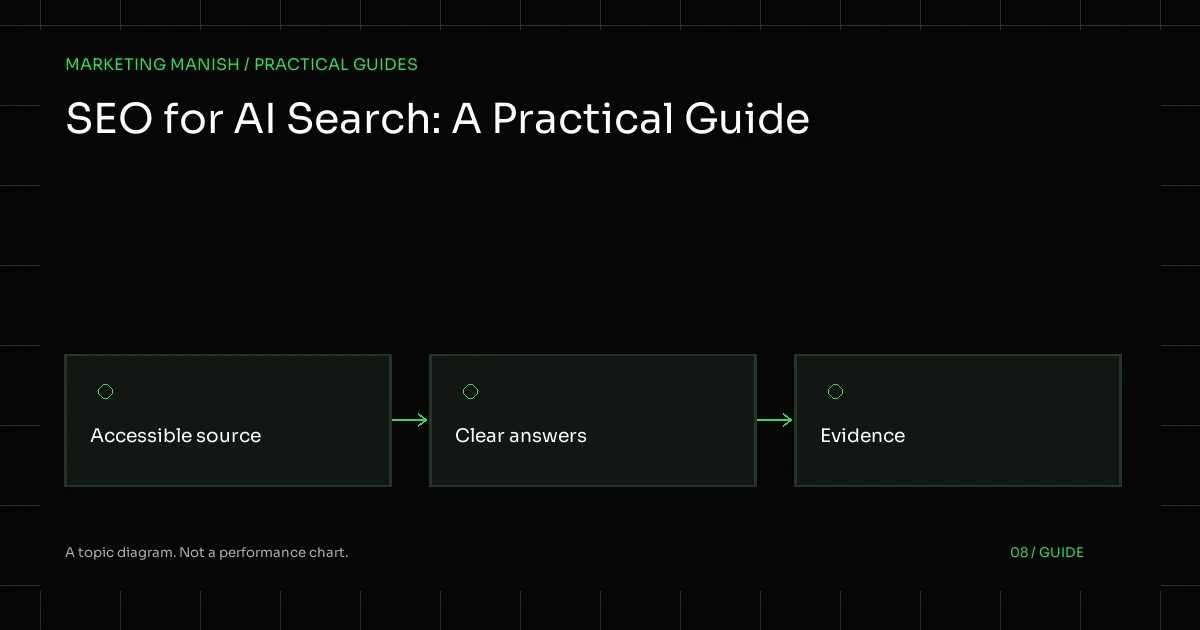
AI search optimization should begin with a realistic boundary: no business can guarantee that an AI system will mention it, cite its page or describe it in a particular way. Answers can vary with the system, question, context and time. A single screenshot is an observation, not a dependable visibility contract.
There is still useful work to do. A business can make source information clearer, improve technical access, publish accurate explanations and connect pages around real questions. Those improvements can help people regardless of how an interface presents search. This guide focuses on that practical work and separates it from unsupported claims about special shortcuts.
Understand the difference between a source and an answer
A website controls its own published pages. It does not control how another service discovers, summarizes or selects information. AI-assisted search may present a synthesized answer, links or other experiences that change over time. The existence of a good page does not force inclusion in every relevant response.
When reviewing an answer, record the query, platform, date and observable source links. Be cautious about drawing conclusions from a personal account or one phrasing. A different user or reformulated question may receive another result. Do not describe a temporary observation as permanent ownership of an AI position.
Google’s guidance on AI features and websites states that its usual SEO foundations remain relevant and does not prescribe a special additional optimization requirement for inclusion. Other systems have their own documentation, so avoid treating one platform’s explanation as a universal rule.
Make the business understandable on its own website
Start with the information a person needs: who the business is, what it provides, who it can help, how the work is delivered and which claims can be supported. A homepage filled with abstract growth language may fail this test even if it contains many fashionable terms.
Use clear service pages and explain scope and limitations. A remote business can state its coverage without inventing offices. A new brand can describe its process without manufacturing experience, client counts or reviews. Structured information should make real facts clearer, not create an appearance of authority unsupported by the business.
Check consistency across owned pages and genuine public profiles. Contradictory names, offers or contact routes make verification harder for people too. A practical AI-search readiness review should begin with those issues before proposing a new label for familiar search work.
Organize answers around genuine questions
Write useful definitions and direct answers where a reader needs them. Follow those answers with the context, practical detail and limitations necessary to avoid misunderstanding. Turning every paragraph into a short slogan can make a page less useful, even if someone describes that format as machine-friendly.
Headings should identify real subtopics. Tables can help compare well-defined options, and step lists can explain a genuine process. Do not add a comparison table whose entries are unsupported or a how-to section that omits important approvals. The structure should follow the information rather than an assumed formula for citations.
A hypothetical service guide might define the service, explain who it suits, describe required inputs and identify what it cannot guarantee. That is useful source material because it reduces uncertainty. It is not proof that an AI system will quote the page or prefer it over another source.
Support claims with real expertise and sources
Review each factual claim and ask where it comes from. Business details should be confirmed by the owner. Technical or policy claims should be checked against appropriate original documentation. Numbers need a reliable source or should be removed. AI-generated confidence does not make a sentence verified.
Use authorship information honestly. A named expert profile should reflect a real person and genuine credentials. If the organization is the author, say so rather than inventing a specialist biography. Do not create fake quotations, endorsements or review markup to make a page appear established.
Original experience can be valuable when the business has permission to share it. If it does not, use a clearly labeled hypothetical example or explain the process directly. A disciplined content workflow should preserve that distinction through drafting, review and publication.
Keep crawling, rendering and navigation sound
Technical access remains a foundation. Important public pages should return the intended response, expose their main information reliably and be linked from relevant parts of the site. Private previews and admin pages should remain private and excluded, even if a marketing experiment would benefit from a larger apparent page count.
Review robots directives, canonical URLs and sitemaps according to the actual intended visibility. Do not copy a blanket bot rule from an unfamiliar tutorial without understanding which agents it affects and what control it provides. Access, indexing and downstream use are different questions with platform-specific mechanisms.
A technical SEO audit can identify obstacles and verify changes. It should not rename ordinary repairs as a secret AI-ranking technique or claim production success from a local build alone. Test the served behavior and document what remains unverified.
Use structured data to describe visible facts
Relevant JSON-LD can connect the organization, website, page and content type coherently. The markup needs valid syntax and accurate meaning. It should not include a phone placeholder, a fictional office or a rating invented for the template. Machine-readable information deserves the same factual review as visible copy.
Use a schema type because the page genuinely fits it, not because the name sounds likely to attract an AI answer. An article, service description and archive have different roles. A step-by-step type should correspond to actual steps visible to the reader. Avoid custom fields that imply unsupported platform relationships.
Additional overview files can be treated as publishing experiments with clear limitations. A file such as llms.txt may summarize the site, but it should not be sold as guaranteed inclusion or an established replacement for proper access controls. Explain what the file actually contains and what evidence supports any claim about its use.
Measure observations without fabricating certainty
Agree on the question being tested before collecting screenshots. You might review whether an important business fact is described accurately or whether a useful source page is cited for a particular question. Keep the sample and method visible so the owner understands what the observation can and cannot support.
Available referral and analytics data can add context, but attribution may be incomplete. An answer might lead to a later direct visit or no visit at all. Do not invent a conversion figure for activity the measurement system cannot observe, and do not treat a change in one report as proof of a single cause.
Separate useful website improvements from platform observations in reporting. A corrected service description is verified work. A particular answer appearing on one date is an observation. This distinction allows the business to benefit from the work without being asked to believe a guarantee the provider cannot control.
Choose a bounded improvement plan
Start with a small set of important pages and an owner-approved fact sheet. Identify unclear explanations, unsupported claims, access issues and missing links. Prioritize corrections that help a real visitor even if an AI interface never cites the page. That makes the plan less dependent on speculative tactics.
Define who supplies expertise, who checks sources and who approves publication. Keep an edit history and use private previews when substantial content changes need review. If a paid tool or external service is proposed, clarify costs and permissions before connecting business data.
Review the plan as platforms evolve, but do not replace every stable foundation whenever a new acronym appears. A responsible process learns from current documentation and observable behavior while acknowledging uncertainty. The business should always be able to understand what was done and why.
Readiness checklist
- Real organization and service information is clear.
- Useful answers include context and limitations.
- Claims, sources and authorship are verified.
- Important pages are accessible and connected.
- Schema matches visible facts and excludes placeholders.
- Experiments are labeled and do not promise inclusion.
- Reports separate completed work from observations.
- Privacy, approvals and paid-tool costs remain controlled.
Keep a useful observation register
A small observation register can include the public question, system, date, visible answer, cited URLs and a note about the account or context used. Keep private customer information out of it. The purpose is to preserve what was actually observed, not to create an artificial visibility score from an unexplained sample.
When an answer contains an incorrect business fact, first check whether the owned source pages are accurate and consistent. Correct information you control, then review any relevant official feedback route. Do not promise that an external answer will update immediately or imply that editing one page gives the business control over every downstream system.
If the business is cited, inspect what the cited page actually supports. A mention next to a question may not endorse the business or imply a partnership. Reports should use careful language and preserve the context. A marketer should never turn an ordinary source citation into an invented award or affiliation.
Review the observations alongside practical website work. Better clarity, safer publication and more useful navigation can be verified directly even when external answer behavior remains uncertain. That gives the owner an understandable basis for continuing the project.
Request a free SEO and marketing audit if you want to identify the most useful foundations before considering a wider AI-search project.