
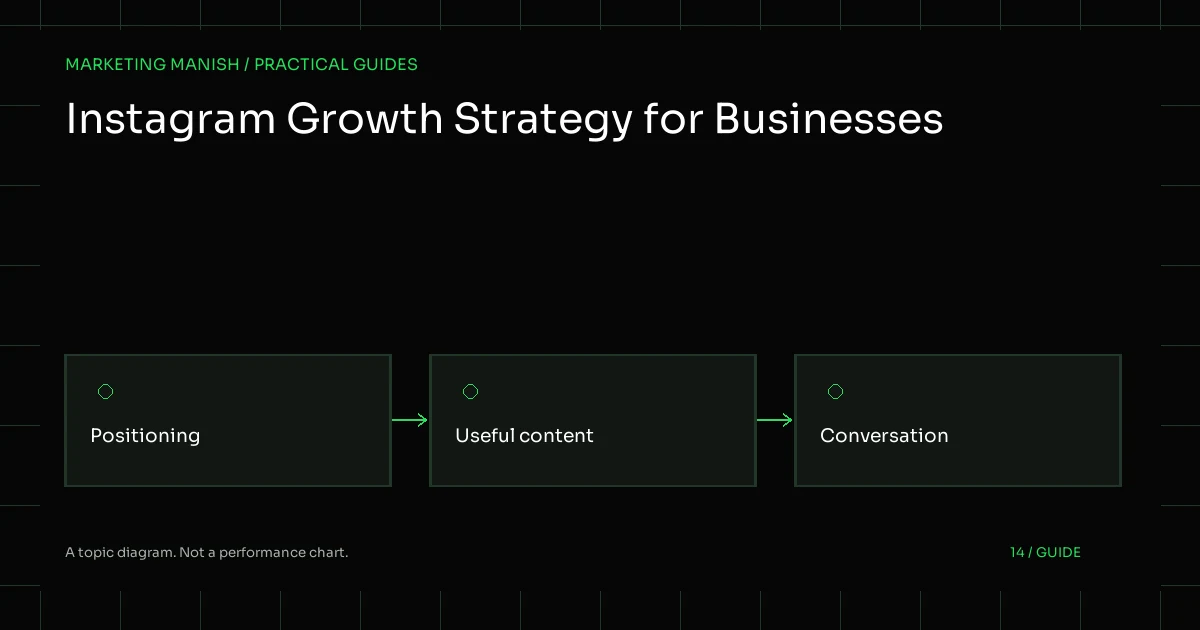
An Instagram growth strategy should explain who the account helps, what useful material it will publish and how relevant interest can become a responsible conversation. It should not depend on bought followers, invented customer stories or a promise that a particular Reel will go viral. Attention can be observed, but its business value needs context.
For a small business, a sustainable plan is more useful than a demanding calendar with no original input. This guide connects positioning, content, Reels production and follow-up. It uses hypothetical planning situations, not client results, and treats platform features and distribution as things the business does not fully control.
Make the profile understandable
A visitor should quickly understand the business, the relevant offer and the next useful step. Review the name, biography, links and highlighted information together. A vague promise of transformation is less helpful than a clear explanation of what the business actually provides.
Keep factual claims accurate. Do not add experience, awards, affiliations or a team size that has not been supplied and verified. If the business works remotely, explain that model instead of inventing a location. A newer account can still be clear and credible without presenting a fictional history.
Test the profile links on a phone. The landing page should match the promise, load usefully and provide a working enquiry path. A social strategy is incomplete if interested people arrive at a broken form or cannot understand which service they were invited to discuss.
Define the audience question behind each theme
Build content pillars from real questions and decisions. Themes might include explanations, preparation, process, limitations and approved business updates. The point is not to assign fashionable labels; it is to create a reliable source of useful ideas the business can actually support.
A hypothetical home-service business could explain what information helps assess a request, what customers should prepare and which work falls outside its scope. That is a planning example, not a completed project. The material should be reviewed by someone who knows the service before it becomes a script.
Keep the number of themes manageable. If the team cannot supply original input or approve the work, a large calendar may fill with generic posts. A focused social media plan should make production and review responsibilities explicit.
Give a Reel one clear job
Decide what the viewer should understand after the video. It might clarify a common mistake, explain one step or introduce a specific offer. A clear job helps the creator choose the opening, visual examples and next action without trying to fit the entire business into one clip.
The opening should accurately represent the content. Avoid a dramatic claim that the rest of the video cannot support. A useful hook raises a relevant question or frames a problem clearly; it does not need an invented statistic, a guaranteed result or a misleading personal claim about the viewer.
Use current Meta information about Reels formats where relevant, while checking the actual interface and account options. Format advice does not establish a guaranteed distribution outcome or replace a useful idea.
Plan original production material
List the footage, demonstrations, graphics or explanations available with appropriate permission. Original does not have to mean expensive. A clear demonstration or well-organized explanation can be more useful than a complex production that communicates little about the real offer.
Do not present stock people as staff, generated scenes as completed projects or another creator’s work as your own. If genuine client material cannot be shared, use an explicitly hypothetical explanation or a neutral diagram. Respect confidentiality and obtain permission before showing identifiable people or customer work.
Prepare a brief with the intended question, important facts, visual sequence, captions and approval owner. This reduces the need to improvise unsupported claims during recording. It also gives an editor a clear basis for choosing what to cut without changing the meaning.
Make the content accessible and readable
Review captions, contrast, framing and the amount of text on screen. People may encounter a video without sound or on a small display. Essential information should not depend on a tiny label, a rapid flash or a voiceover that is difficult to understand.
Keep graphics and motion in service of the explanation. Decorative effects can distract from a practical process or obscure a qualification. If the video discusses a limitation or condition, do not hide it in unreadable text while emphasizing the promotional claim.
Check the final output rather than only the editing timeline. Read the caption, follow the link and verify that the destination explains the same offer. Accessibility and factual review should be normal production checks, not optional finishing touches added only when a complaint occurs.
Choose a sustainable publishing rhythm
There is no universal posting cadence that guarantees growth for every business. Choose a rhythm the team can maintain with useful ideas, original input and reliable approvals. A plan that depends on daily last-minute improvisation can make accuracy and consistency harder to preserve.
Batch related production where it helps, but review each item in context. An old availability statement or a seasonal offer may become inaccurate by its scheduled date. Someone should own the final publishing check and know how to pause an item when the underlying facts change.
Use the calendar to coordinate work, not to pressure the business into inventing activity. It is reasonable to publish less while improving the source material. The purpose is a coherent account and useful audience interaction, not a count of posts detached from quality.
Turn interest into an appropriate conversation
Define how comments and direct messages are handled. Decide which questions have approved public answers, which need a private response and which should be escalated to a person with relevant knowledge. The account should not promise availability or advice that the responding team cannot provide.
A DM is not automatic permission for every future marketing message. Keep follow-up relevant and respect preferences. Avoid bulk unsolicited outreach or automation that pretends to be a personal relationship. Sensitive customer information belongs in a suitable protected process, not a public comment thread.
An Instagram strategy should connect the content and conversation paths. If a visitor needs to submit a project brief, direct them to a clear, secure form rather than asking for passwords or unnecessary personal details in the chat.
Review evidence without chasing vanity
Available reach, retention, saves, interactions and profile activity can help evaluate whether a piece was understood or useful. They do not automatically establish a qualified enquiry or sale. Keep definitions visible and compare observations with the actual purpose assigned to the content.
Look for patterns in questions and misunderstandings. If people repeatedly ask what the service includes, the content or profile may need a clearer explanation. If a format attracts attention from an unsuitable audience, more of the same attention may not be a useful growth objective.
Do not invent attribution where the systems cannot observe a journey. A person may return later through another channel, or interact without buying. Reports should explain those limits instead of converting every positive signal into a commercial claim.
Use experiments to improve the next brief
Choose a small, clear question for the next test: a different explanation, a more specific audience problem or a simpler next action. Record what changed and what evidence was available. Avoid presenting simultaneous changes to every part of a campaign as a controlled comparison.
Connect useful ideas across channels thoughtfully. A guide can support a short video, and a recurring DM question can become an editorial brief. A content marketing process should adapt the explanation to each context rather than paste the same message everywhere.
Keep ownership and permissions documented if creators or suppliers are involved. The business should understand usage rights, account access and what happens when an engagement ends. A reliable production system is part of responsible growth, even though it is less dramatic than a promise of virality.
Working checklist
- The profile states a genuine offer and next step.
- Content themes answer real audience questions.
- Every Reel has a clear, truthful purpose.
- Footage, imagery and claims are approved.
- Captions and small-screen readability are checked.
- The publishing cadence is sustainable.
- Comments and DMs have a responsible owner.
- Reports distinguish attention from useful enquiries.
Keep approvals practical for a small team
Create a short review sheet for each planned item: the audience question, approved facts, required footage, usage permissions and intended next step. The person approving it should be able to see the actual final caption and visual, not just a title in a calendar.
Flag anything that depends on availability, a customer’s permission or a professional claim. Those details should be confirmed before scheduling. If confirmation is missing, use a different useful topic or keep the item private rather than filling the gap with a stock story.
After publication, record recurring audience questions and any important correction. This can improve the next brief without turning every comment into a marketing data point. A small team benefits from a simple, repeatable process that protects quality and makes responsibilities clear, even when the content schedule is modest.
Use a free marketing audit request to review the profile, website and follow-up together before committing to a larger production schedule.