

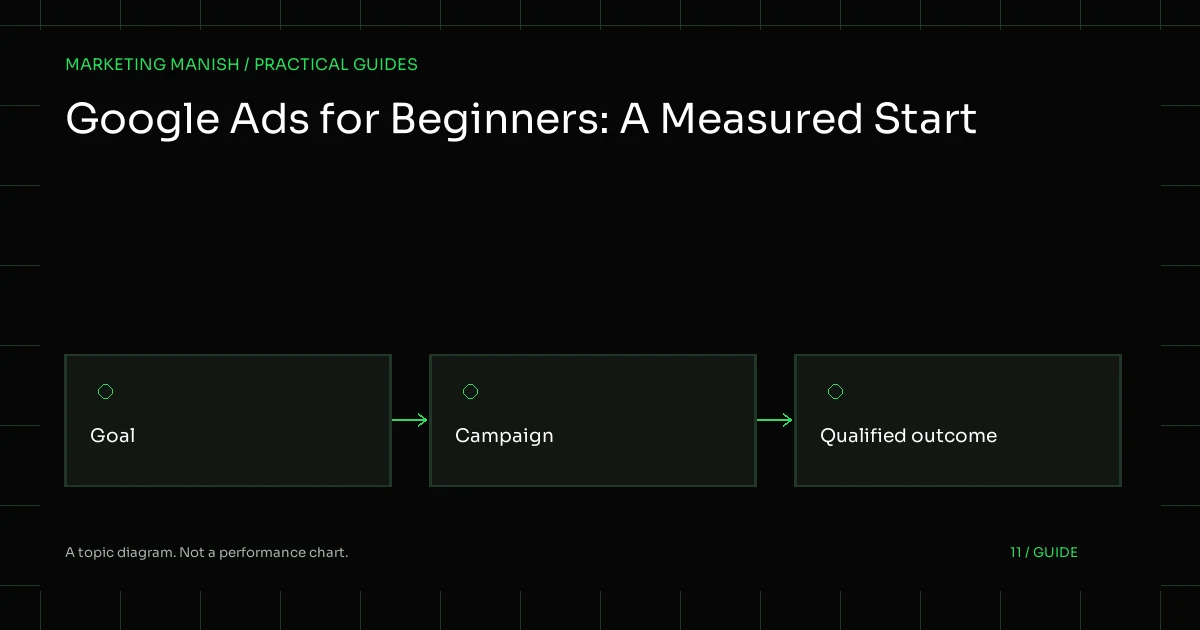
Google Ads for beginners should start with a business decision: what are you offering, to whom, and what useful action should advertising support? Opening an account is easier than defining a dependable conversion path. A campaign can spend money and produce clicks while leaving the owner unsure whether any of the activity helped.
This guide describes a measured first campaign, not a guaranteed profitable one. The offer, margins, competition, landing page and follow-up all influence the outcome. Use a bounded budget, clear ownership and a plan for interpreting evidence before expanding. Platform settings change, so consult current official guidance for the exact interface and options.
Choose one useful starting objective
Write down the action the business actually values. It might be a qualified service enquiry, an appropriate quotation request or a completed purchase. Be specific about what makes that action useful. A form containing a phone number is not necessarily a suitable prospect, and a click-to-chat action does not confirm a conversation.
Then identify the offer and audience that support the objective. A hypothetical repair campaign could focus on a defined service and a real coverage area instead of advertising every related term. This is a planning example, not a statement about demand, costs or results for a particular business.
Check capacity before buying traffic. Who will respond, how will the enquiry be assessed and where will the outcome be recorded? Advertising cannot repair an undefined handoff on its own. Make the operating process part of the brief rather than an issue discovered after spend begins.
Keep ownership and billing clear
The business should retain control of its advertising account and billing relationship. Grant a provider the appropriate role instead of sharing a password or handing over the only owner login. Agree on what happens when access changes or the engagement ends.
Separate media spend from management fees, landing-page work, creative production and paid tools. A proposal should make those boundaries visible. The owner needs to know which charges are controlled by the platform, which work is included and what requires additional approval.
Use Google’s official Ads guides for product concepts and current setup routes. Do not assume that a platform’s suggested campaign or budget automatically matches the business’s learning goal or commercial constraints.
Define and test conversion tracking first
A measurement plan should distinguish clicks, successful submissions, qualified enquiries and sales. Decide which event will be used for campaign evaluation and why. Naming every interaction a conversion can make the account look active while obscuring whether the business received anything useful.
For a form, test the confirmed successful outcome. Invalid submissions, network failures and repeat requests should not inflate the count. Store the enquiry before attempting notification email, and keep private fields such as email addresses and phone numbers out of general event payloads.
A GA4 and GTM tracking review should also check consent, duplicate tags and the relationship between analytics and advertising conversions. The systems may have different definitions and attribution, so explain expected differences rather than promising identical reports.
Prepare a landing page that matches the offer
The visitor should recognize the offer described by the ad. Use a clear headline, useful scope information and an appropriate next step. Do not send a narrowly focused ad to a vague homepage if the visitor must search again to find the relevant service.
Use only real proof. If testimonials, ratings or case studies have not been supplied, keep those sections hidden. Explain the process, limitations and ownership instead of manufacturing credibility. A small honest page is more defensible than a polished page filled with invented evidence.
Check mobile layout, required fields, error messages and the no-JavaScript path. A landing-page review should verify actual form storage and a usable confirmation, not just a button animation or an attractive desktop mockup.
Build targeting around relevant intent
Research the language a suitable buyer uses and group related searches around a clear need. Learn how the available matching options work in the current platform. Do not assume that the words typed into a keyword field will always limit traffic exactly as an inexperienced user expects.
Write down obvious mismatches before launch, then review available search-term evidence after the campaign runs. A hypothetical service business may need to distinguish customer enquiries from employment, training or unrelated products. Exclusions should follow the actual offer and evidence rather than a copied universal list.
Geography also needs an operational basis. Target the places the business can genuinely serve and review the current location settings carefully. A selected region is not a promise of immediate availability, a local office or the ability to handle every enquiry from that area.
Write truthful ads and suitable assets
Explain the service, its relevance and a useful next step. Keep claims consistent with the landing page and approved business facts. Do not add “guaranteed,” “official partner” or a fabricated offer merely because the wording seems likely to attract attention.
Prepare the assets needed for the chosen campaign type. Search, Performance Max and YouTube involve different inputs and tradeoffs. Choose a scope that the business can support with appropriate creative and review. Automation does not remove the need for accurate source material and human judgement.
Document approvals and policy concerns before launch. Some sectors and claims need additional care. A provider should explain when a platform review or eligibility issue is unresolved rather than promise that a workaround will secure approval.
Set a bounded learning budget
There is no universal starting budget suitable for every small business. Consider the offer, margin, expected sales process, market and the amount the owner can responsibly allocate to learning. A planning assumption should be labeled as an assumption rather than presented as a guaranteed cost per customer.
Agree on spending controls, review responsibilities and what would justify a pause or expansion. Avoid a plan in which the owner cannot distinguish a deliberate test from unmonitored spend. Explain how current platform budget behavior works before relying on an intuitive interpretation of a daily setting.
Do not expand the scope merely because early activity looks busy. First verify tracking, relevance and the business’s response process. A small amount of useful evidence can support a better decision, while a larger volume of poorly understood data can increase confusion.
Review quality, not just a headline number
Look at spend, targeting evidence, landing behavior and actual enquiry outcomes together. A lower cost per form may be unhelpful if the forms are unsuitable or duplicates. The business needs a reliable way to tell the campaign manager what happened after the initial submission.
Distinguish observed associations from causes. A sales change may involve pricing, availability, seasonality or another channel. Keep a dated change record and avoid changing every major variable at once when the purpose is to learn from a particular test.
A Google Ads management plan should explain what was done, what the available evidence suggests, what remains uncertain and which decision comes next. It should not promise profitability simply because a campaign is configured correctly.
First-campaign checklist
- The objective and qualified outcome are defined.
- The business owns accounts and billing.
- Media spend and service fees are separated.
- Tracking is tested for success, errors and duplicates.
- Consent and private-data boundaries are respected.
- The landing page matches the offer and works on mobile.
- Targeting, exclusions and creative have a clear rationale.
- Budget controls and review responsibilities are agreed.
- Reporting includes real lead quality and limitations.
Walk through a hypothetical launch review
Suppose a business is preparing one service campaign. Before approving it, the owner confirms the service scope, actual coverage and who handles enquiries. The campaign manager explains the targeting and exclusions. The website owner checks the landing page and the developer verifies successful storage, validation errors and duplicate handling. No performance result is assumed in this example.
The team then reviews a clearly labeled test enquiry. It should appear once in the protected CRM, with the expected source and no private information sent to analytics. If notification email is part of the process, test the configured SMTP and inbox path separately. A campaign should not launch on the assumption that a visible success message proves every downstream step.
Next, review the reporting definition. The owner should know whether the campaign’s important action is a stored request, a qualified conversation or another event. If qualification happens later, agree how the sales team will provide that feedback. Do not let a convenient platform default silently define the business’s commercial success.
Finally, record the approved spend, the people authorized to change it and the evidence needed at the next review. Include what would prompt a pause, such as broken tracking, unsuitable traffic or a service-capacity problem. The goal is not to predict every result; it is to make the experiment controlled and understandable.
After launch, verify that the actual served page and measurement still match the review. Production caches, account settings and template changes can introduce differences. Keep an issue list with a responsible person and a concrete next action instead of leaving the owner to infer readiness from campaign status alone.
If those foundations are uncertain, request a free SEO and marketing audit before committing to a broader campaign scope.