
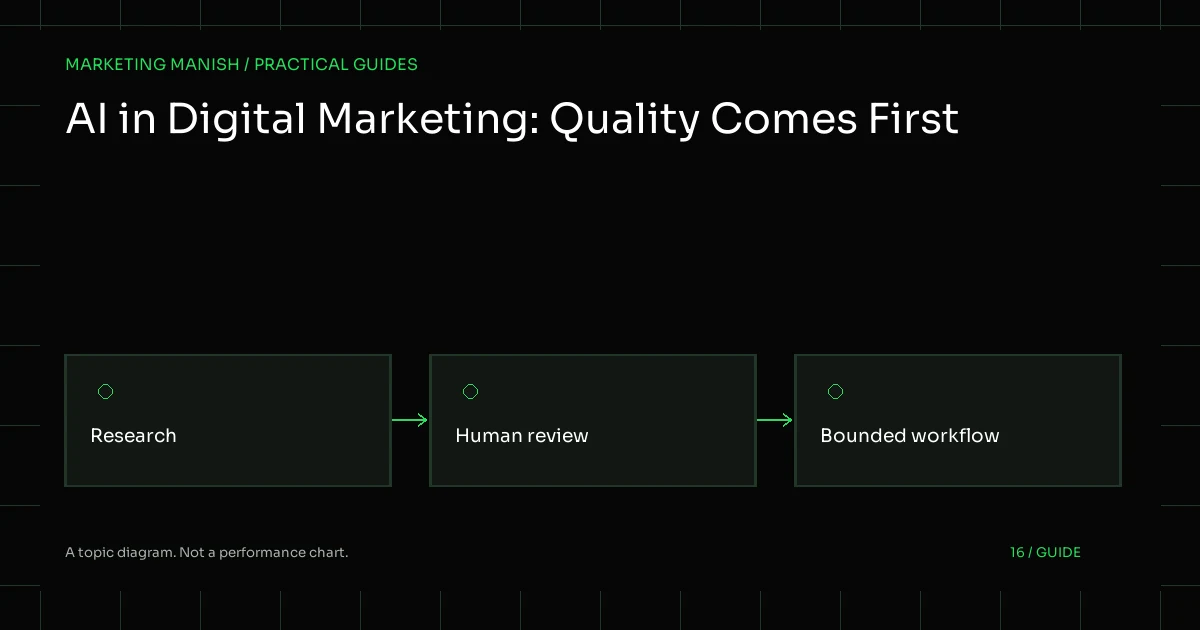
AI in digital marketing is most useful when it supports a defined task and a clear review process. It can help organize research, prepare draft variations or reduce repetitive handling. It does not remove responsibility for accuracy, privacy, permissions or the final decision, and it cannot guarantee that a campaign or article will perform well.
Start with the workflow rather than the tool. What information enters, what action is allowed, who checks the result and what happens when the system is wrong or unavailable? Those questions help a business choose a bounded use case instead of connecting every account to a service it has not evaluated.
Choose a task with an understandable boundary
List repetitive work and identify which parts involve judgement or sensitive information. Organizing approved notes is different from deciding whether a customer is eligible for a service. Drafting alternative headings is different from publishing them automatically. Make those boundaries explicit before discussing automation.
A hypothetical team might use AI to turn an approved interview transcript into a draft outline. A human would still check facts, meaning, omissions and permissions. This is a workflow example, not a claim about a client’s time savings or a measured productivity result.
Begin with a task whose output can be reviewed and corrected. Define what a good result looks like, what errors matter and how the process can be stopped. A small, testable workflow is easier to evaluate than a broad promise to automate marketing end to end.
Use AI to organize research, not invent evidence
AI can suggest questions, group notes and identify topics that need investigation. Treat the output as a research aid, not as a verified source. A generated citation, quote or statistic must be checked against the original material before it appears in public content.
Keep a source record for important claims. If an apparent source does not exist or does not support the statement, remove the claim. Do not convert uncertainty into a numerical estimate just because a draft feels incomplete without one. Useful explanation can often be written without an unsupported number.
Google’s guidance on generative AI content is a relevant official reference for search publishing. The practical editorial obligation remains to produce accurate, useful material with a real purpose rather than generate volume for its own sake.
Preserve the business’s original expertise
A useful draft needs source material from people who understand the offer. That can include approved notes, product documentation, demonstrations and real process explanations. AI should not fill missing business facts with plausible guesses about experience, qualifications, pricing or customer outcomes.
Ask an expert reviewer to identify what is wrong, missing or too certain. The reviewer should not be limited to proofreading style. A smooth paragraph can still misrepresent scope or omit an important limitation. Record corrections so later drafts do not repeatedly reintroduce the same mistake.
A human-led content workflow should distinguish drafting assistance from authorship evidence. Do not create fictional expert profiles or use a stock portrait to imply that an invented person reviewed the material. Organization authorship is preferable to a fabricated credential.
Draft useful variants with controlled inputs
AI can help explore different ways to explain an approved message. Supply the actual offer, audience, tone and claims that may be used. Also state what must not be implied. This reduces the chance that a variation introduces a guarantee or a detail the business never approved.
Review each variant independently. A short ad can become misleading if a caveat disappears or an example becomes a claim of completed work. Keep important limitations visible in the destination and do not let persuasive wording outrun the available evidence.
Use variations to test a clear question rather than create an endless pile of options. Document what changed and why. A provider should explain the intended learning and the measurement limits instead of presenting the use of AI itself as proof of better results.
Protect information before connecting a tool
Review what data a provider receives, why it is needed, who can access it and how it is handled. Customer records, private messages, credentials and sensitive business documents should not be pasted into an unapproved tool simply because the interface is convenient.
Use the minimum information needed for the task. De-identify examples where appropriate and keep secrets outside prompts and ordinary logs. An anonymized workflow description may be sufficient for planning without uploading the underlying customer database or a full conversation history.
Paid services and ongoing API charges require explicit approval. Identify provider accounts, billing ownership and access revocation before integration. The business should understand the dependency and cost rather than discover a new subscription after a prototype has already been connected.
Design automation around approvals and fallback
Map the trigger, permitted action, review point and final destination. A draft reply can be prepared for a human without being sent automatically. A content item can be organized into a review queue without being published. The boundary should match the consequences of an error.
Provide a manual fallback. If a provider is unavailable or returns an uncertain answer, the workflow should pause, route to a person or preserve the item for review. It should not silently drop an enquiry, invent a response or retry indefinitely without visibility.
An AI automation scope should include normal and failure tests, ownership and a way to stop the process. A browser demonstration or a successful API request is not proof of reliable production operation.
Keep assistants inside approved knowledge
A customer-facing assistant needs a defined information source and limits. It can explain approved service details or help route a question, but should not guess prices, availability, professional advice or a customer’s private situation. Missing knowledge should lead to an honest escalation.
Test requests that are ambiguous, outside scope or deliberately misleading. Check that the assistant does not reveal private instructions, another customer’s details or credentials. Restrict the tools it can invoke and avoid giving a conversational model broad administrative permissions.
Make human contact clear. Someone should own escalated requests and understand what the assistant has and has not done. Automation that makes a person repeat everything without explanation can create friction instead of reducing repetitive work.
Evaluate content quality separately from output volume
Count completed, reviewed work rather than treating generated words as a business outcome. A shorter accurate guide can be more useful than several repetitive pages. Search content still needs a reader purpose, technical access and a credible explanation of the subject.
An AI-search review should not promise citations or inclusion merely because the content was produced with a particular tool. Other systems control their own answers. Keep website improvements and external answer observations distinct in the report.
Watch for repetition across pages. A template can make production faster while leaving every location or service description nearly identical. Require distinct, useful information before publication and keep unreviewed pages private rather than scaling a weak pattern.
Review costs, maintenance and actual evidence
Record the provider, model or service configuration relevant to the workflow, along with costs and approval responsibilities. Outputs can change when a service changes. Someone should own regression checks and understand which parts of the process depend on external behavior.
Measure the actual question being tested. If the goal is to reduce a repetitive step, compare the complete reviewed process, including corrections and approvals. Do not invent a time-saving percentage from the speed of generating a first draft alone.
Keep a clear exit route. The business should retain its source material, approved content and account ownership. If the tool is no longer suitable, the workflow should be understandable enough to replace without losing enquiries or the ability to publish responsibly.
AI workflow checklist
- The task and permitted actions are defined.
- Inputs are accurate, approved and minimal.
- Claims and citations are checked against original sources.
- Human review covers meaning and facts, not just style.
- Sensitive information and credentials stay protected.
- Costs and provider access are approved.
- Failure paths and manual escalation are tested.
- Reports measure reviewed work and real outcomes.
Make a review gate concrete
Before a draft is approved, ask a reviewer to identify the source of every important business fact and any sentence that sounds more certain than the evidence. Record whether the offer, audience and limitations are still correct. A checklist should be specific enough that another person can repeat the review, not merely contain a box labeled “quality checked.”
For a hypothetical content workflow, the allowed output could be an outline and a draft stored privately. Publication remains a separate action. If the model returns an unsupported quote or a nonexistent source, the item should return for research rather than move forward because the prose reads well. Keep the failure visible to the operator without copying private source material into a general log.
Review a small sample after a tool or prompt changes. A previous success does not prove that a revised workflow preserves the same boundaries. Compare factual accuracy, missing qualifications and the amount of correction required. The business can then decide whether the assistance is actually useful, rather than measuring success only by how quickly an initial response appears.
Request a free marketing audit to identify a bounded use case before connecting paid tools or automating customer-facing actions.